
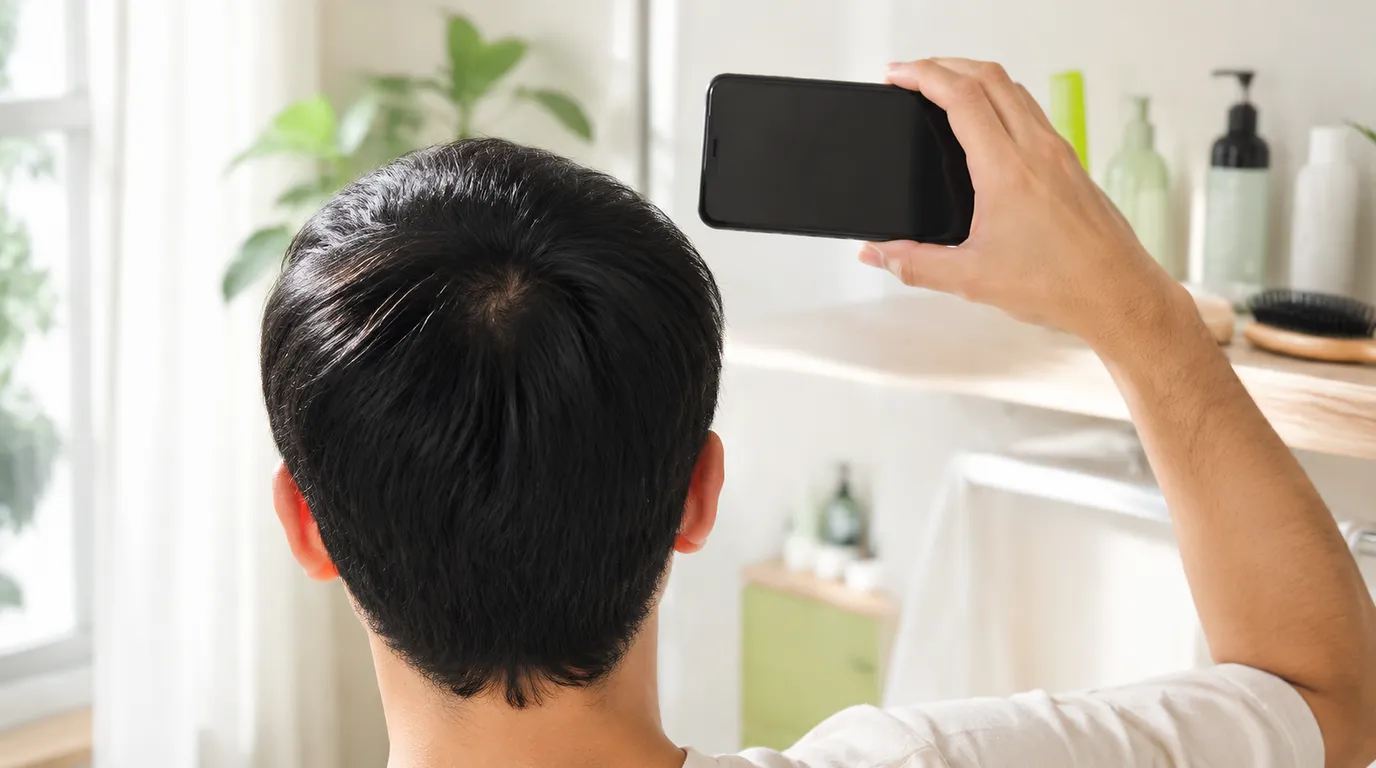
Most people check their hair the same way: a quick glance in the bathroom mirror, usually under a harsh overhead light, usually when something already worries them. It is the least reliable way to read your own scalp — the angle changes, the light changes, your mood changes, and your memory of “how it looked before” quietly drifts. Photos fix almost all of that, but only if you take them the right way and read them with honest expectations.
This is a practical guide to doing exactly that. It will not tell you that you are balding, and it will not promise regrowth. It will help you capture and read appearance-based signals — visible coverage, hairline shape, and scalp surface — as something you can compare against yourself over time.
Why photos beat the mirror
The mirror gives you one angle, flipped, lit by whatever bulb is overhead, at a different time of day each time. None of those variables are controlled, so a “bad hair day” and a real change look identical. A photo lets you hold conditions still: same framing, same light, same crop. When two things are captured the same way, a difference between them is far more likely to be a real difference — not just a different moment.
The crown is the clearest example. You physically cannot see the top-back of your own head in a single mirror, which is why most people first hear about crown thinning from a photo someone else took. A phone, held overhead or handed to a friend, simply sees it.
The four angles that matter
You do not need a studio. You need four consistent angles, because different parts of your scalp reveal different signals, and each is best seen from one specific direction.
| Angle | Best read from this view | Common mistake |
|---|---|---|
| Front | Hairline shape, temple corners, edge density | Tilting the chin down, which fakes a lower hairline |
| Top | Crown coverage, part width, overall density | One harsh light that exaggerates scalp show-through |
| Side | Temple-to-crown transition, sideburn density | Letting hair fall across the temple and hide the line |
| Back | The lower crown and whorl, the true blind spot | No second mirror, so the shot is blurry or cropped |
The point of fixing these four angles is not the single snapshot — it is the comparison later. If your front photo is framed the same way in March and in June, the two are genuinely comparable. If they are not, you are comparing two different camera positions and calling it a change in your hair.
How lighting fools you
Lighting is the single biggest liar in scalp photos. The same head can look dramatically different in two photos taken minutes apart, purely because of the light.
- Harsh overhead light and flash exaggerate scalp show-through — the crown looks far thinner than it is.
- Soft, even, indirect light flatters coverage — things look fuller than they are.
- Wet hair clumps together and shows more scalp, which reads as thinning even when nothing changed.
- Backlighting (a window behind you) turns thin edges translucent and dramatic.
What to actually look for
Resist the urge to count hairs or assign yourself a percentage. A phone photo cannot honestly support a number like that, and any tool that hands you an exact follicle count is overselling it. What photos can show, fairly, are a handful of visible signals best read as tiers — roughly low, medium, or high — that stay stable between two photos of the same head.
Hairline shape
Look at the overall silhouette across your front view — even, slightly set back, or an M-shape at the temples. There is no single “correct” hairline; even, mature, and M-shaped lines are all common at every age. What matters for tracking is whether the shape holds or keeps moving between identical photos.
Crown coverage
On your top and back views, look at how much scalp shows through around the whorl under even light. Every crown has a swirl where hair fans out from a center point, and it can read sparse without being thin. Read the whole area, not just the center point, and compare it only against your own earlier photo.
Scalp surface
Where the photos actually show it, you can note visible surface signals — shine along the part where there is oil, flakes at the partings when it is dry, redness. Describe what you see; do not name a condition. A flake is a flake in a photo, not a diagnosis.
Where a photo's honesty ends
This is the part most guides skip. A photo has hard limits, and pretending it doesn't is how people end up anxious over noise. A 2D image cannot measure hair caliber, density per square centimeter, or anything beneath the skin. It cannot tell you why something looks the way it does. And a single photo, no matter how good, cannot tell you about change — change needs two photos taken the same way, weeks or months apart.
Making it repeatable
The whole value is in the second photo. One scan is a snapshot; two identical scans a few months apart are a trend. Visible change is slow, so checking obsessively every morning mostly measures lighting and mood. Every 8 to 12 weeks, with the same four angles and the same light, is plenty — and a flat, stable comparison is a genuinely good answer to get.
If holding all those variables steady by hand sounds tedious, that's exactly the part a guided scan handles for you: fixed framing on each of the four angles, a confidence level on every reading, and your result saved as a baseline so the next scan compares fairly against your first. You can preview a full report free, without an account, and decide for yourself whether the read is honest.
Questions
Good to know.
Can I really read my own scalp from a phone photo?
You can read visible, appearance-based signals — hairline shape, crown coverage, surface shine or flaking — as rough tiers, and compare them against your own earlier photos. You cannot get an exact density number or a diagnosis from a photo, and you should be wary of anything that claims otherwise.
What lighting is best for scalp photos?
Soft, even, indirect light with dry hair. Avoid harsh overhead bulbs, direct flash, backlighting, and wet hair — each one distorts how much scalp shows through. The exact setup matters less than using the same one every time.
How often should I take comparison photos?
Every 8 to 12 weeks is enough. Visible change is slow, so daily checks mostly capture lighting and styling differences rather than real change. Identical angles a few months apart give a fair comparison.
Is reading my scalp in photos a diagnosis?
No. It is informational and appearance-based — a way to track how things look over time. It does not diagnose, treat, or cure anything. For pain, sudden shedding, patchy loss, or signs of infection, see a qualified professional.