
If you have started worrying about your hair, the urge is almost always to check it constantly — every mirror, every shop window, every front-facing camera that catches the top of your head. It feels responsible, like staying on top of the problem. It is actually the fastest route to anxiety, because checking daily measures all the wrong things. The honest question is not whether to check your hair, but how often — and the answer is far less often than your worry wants.
This is a practical guide to cadence: why a daily check mostly captures lighting, styling, and mood rather than real change, why every 8 to 12 weeks is the sweet spot most people land on, what actually moves slowly enough to be worth tracking, and why a flat, unchanged result is one of the best answers you can get. It will not tell you that you are balding, and it will not promise regrowth. It will help you check at a rhythm that gives you information instead of dread.
Why daily checking lies to you
A daily check feels like data, but it is mostly noise. The thing you are really measuring from one morning to the next is rarely your hair — it is everything around it. The light is different, your hair is wetter or drier, it is styled differently, and your mood colours how you read what you see. Any of those can make the same head look noticeably fuller or thinner with nothing about your actual hair having changed. Stack a worried mood on top of a harsh bathroom bulb and a daily check becomes a machine for manufacturing alarm.
- Lighting swings hardest. Harsh overhead light and flash exaggerate scalp show-through; soft, even light flatters coverage. The same crown can look thin at 7am and full at noon.
- Wet versus dry matters. Damp hair clumps together and shows more scalp, so a post-shower check reads as thinning that dries away an hour later.
- Styling moves the line. A different part, a flattened fringe, or a day-two texture changes the silhouette far more than a day of real change ever could.
- Mood reads the photo for you. On an anxious day you notice every gap; on a good day you barely look. The hair didn't change — your attention did.
None of these are your hair changing. They are the conditions changing, and a daily check has no way to separate the two. So the more often you look, the more of this noise you collect, and the more convinced you become that something is moving — when all you have really captured is a different moment.
How slowly hair actually changes
The reason daily checking is pointless comes down to biology: visible hair change is slow. Hereditary hair loss in particular is gradual — the American Academy of Dermatology describes it as a slow process in which follicles shrink over time, and dermatology references describe androgenetic alopecia as a gradual, predictable pattern that unfolds after puberty, not week to week. Whatever is or isn't happening to your hair, it is almost never visible between one day and the next.
That single fact reframes the whole question. If real change takes months to become visible, then any difference you think you see overnight is, by definition, almost certainly not real change — it is the lighting, the water, the styling, the mood. Checking daily asks a slow process to report progress on a fast schedule, and the only thing fast enough to fill that gap is noise. The cadence that makes sense is the one that matches how the hair actually moves: slowly, over seasons.
Why 8 to 12 weeks is the sweet spot
If daily is too often, the obvious question is how often is right. The answer most people land on is every 8 to 12 weeks — roughly a season between checks. It is not an arbitrary number; it is the window where the signal finally outweighs the noise. Long enough that genuine, slow change has had room to actually appear, and short enough that you are not waiting years to learn anything or letting a real shift go unnoticed.
| How often | What you mostly capture | Honest verdict |
|---|---|---|
| Several times a day | Lighting, mood, and the angle of whatever surface you caught your reflection in | Pure noise — this is the anxiety loop, not tracking |
| Daily | The day's lighting, wet-vs-dry hair, and styling, with no fair point of comparison | Still noise; real change can't show this fast |
| Weekly | Mostly styling and lighting differences; far too short for slow change to register | Tempting, but mostly measures conditions, not hair |
| Every 8 to 12 weeks | Genuine change, because slow movement has had a season to become visible | The sweet spot — signal finally beats noise |
| Once a year or less | Real change, but you may miss a meaningful shift for months | Honest, just slow to react if something is moving |
There is room to flex inside that window. If you have a specific reason to watch more closely — you have started a routine you want to fairly assess, or a professional has asked you to keep an eye on something — leaning toward the 8-week end is reasonable. If your hair has been stable for a long time and you are simply keeping a record, every 12 weeks, or even twice a year, is plenty. The principle holds either way: a season, not a day.
How a fixed schedule makes the comparison real
Cadence is only half of it. Checking every 8 to 12 weeks is what removes the noise of time; taking each check under identical conditions is what removes the noise of the moment. Get both right and a difference between two checks is far more likely to be a real difference in your hair. Get either wrong and you are back to comparing two different moments and calling it change. A schedule you actually keep, with conditions you can reproduce, is what turns a habit into evidence.
- Same conditions, every time. The same four angles, the same soft even light, dry hair before product — so the only thing that can differ between two checks is the hair itself.
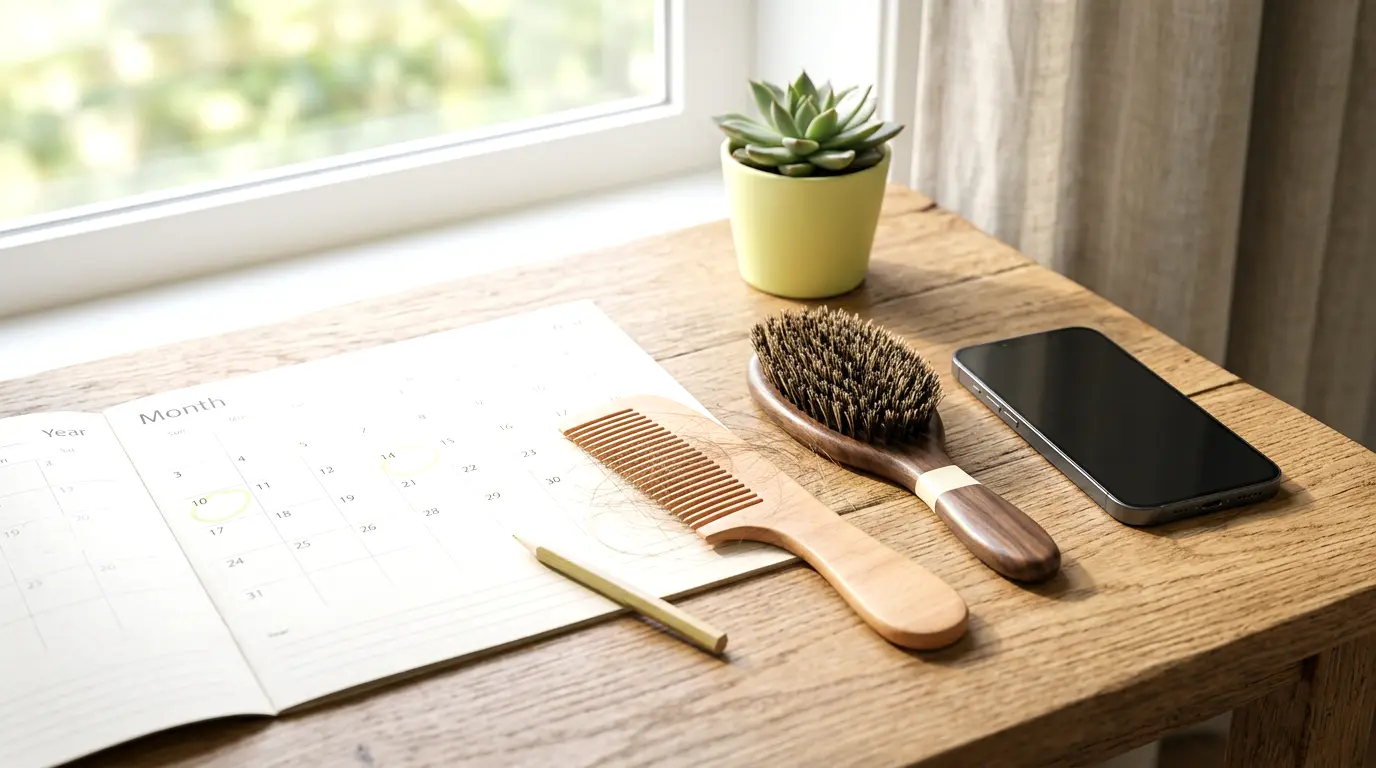
- A fixed interval, written down. Put the next check on a calendar 8 to 12 weeks out, so you compare against a real date instead of a half-remembered sense of how long it's been.
- Compared against your own last photo, not your memory. Memory quietly drifts to match your current mood; a dated photo doesn't.
- The whole area, not one anxious spot. Read the crown or hairline as a region across both checks, rather than fixating on a single point each time.
This is also why the comparison should be read as a direction, not a precise number. A phone photo cannot honestly support a figure like "your density dropped from 64% to 61%" — the same head photographed twice minutes apart can produce two different precise-looking numbers from lighting alone. What a fair, scheduled comparison can support is a tier and a direction: coverage reads roughly medium, and it is holding steady, or it is moving. That is a far more trustworthy read, and it is exactly why staging tools like the Norwood-Hamilton scale describe hair loss in broad stages rather than decimals. Our guide on tracking hair changes over time goes deeper on building a fair baseline; this one is just about how often to return to it.
Why a flat, stable result is a good answer
People often approach a check braced for bad news, and then feel oddly deflated when the comparison shows nothing moving — as if the check was wasted. That reaction is backwards. A flat, stable, unchanged result is one of the best answers a check can give you. The NHS notes that hair loss is usually nothing to be worried about, and a comparison that simply isn't moving is direct, personal evidence of exactly that. Stability is information, not an absence of it.
It also explains why obsessive checking backfires on its own terms. The thing the anxious daily-checker actually wants is reassurance that nothing is changing — but they check so often, under such noisy conditions, that they can never get a clean read, so the reassurance never comes. A scheduled check under steady conditions delivers the very thing the daily check keeps failing to: a clear, honest "still holding," logged and dated. The calm version of hair tracking isn't dramatic good news. It is "no change," confirmed every season, until the record itself becomes the reassurance.
Making the cadence effortless
The honest weak point of any tracking habit is consistency. It is easy to take a good first set of photos, and surprisingly hard to reproduce the exact same angles and light a season later — which is how people end up comparing a sharp baseline against a wonky follow-up and reading a "change" that was never real. The cadence only works if each check genuinely matches the last, and holding all of that steady by hand, months apart, is where casual tracking falls apart.
That repeatability is exactly the part a guided scan is built to handle: it fixes the framing on each of the four angles so your follow-up lines up with your baseline, puts a confidence level on every reading instead of inventing a number, and saves your first result as a dated baseline so every later scan compares fairly against your real starting point — and tells you when it's time to check again. If you want to dig into doing the comparisons themselves well, our walkthrough on how to track hair loss covers the method; the rhythm is the simple part. Check every 8 to 12 weeks, under the same conditions, and let a flat result be the good news it is. You can preview a full appearance-based report free, without an account, and judge for yourself whether the read is honest before you trust it with your baseline.
Questions
Good to know.
How often should I check my hair or scalp?
Every 8 to 12 weeks — roughly once a season — is the honest sweet spot. Visible hair change is slow, so checking daily or weekly mostly captures differences in lighting, styling, and mood rather than real change. A season between checks is long enough for genuine movement to show through and short enough that you learn something each time.
Why shouldn't I check my hair every day?
Because a daily check mostly measures the conditions, not your hair. From one morning to the next, the lighting, whether your hair is wet or dry, your styling, and your mood all change far more than your actual hair does. Real hair change is gradual and takes months to become visible, so a daily check collects noise and manufactures anxiety rather than giving you a fair read.
How frequently should I take comparison photos?
On the same 8-to-12-week rhythm, and always under identical conditions: the same four angles, the same soft even light, and dry hair every time. The fixed interval removes the noise of time and the identical conditions remove the noise of the moment, so any difference between two photos is far more likely to reflect your hair rather than the day you took them.
Does it ever make sense to check more often than every 8 weeks?
Rarely, and only for a specific reason — for example, if a qualified professional has asked you to keep a closer eye on something. Even then, the limit is physics: real change still takes months to appear, so checking more often won't reveal it sooner, it will just add noise. For most people, leaning toward 8 weeks when actively watching and 12 weeks when simply keeping a record covers it.
Is a stable, unchanged result a waste of a check?
No — it's one of the best answers you can get. A flat comparison is direct evidence that your hair is holding, not a wasted scan, and each unchanged dated check makes your record stronger and more reassuring. This is informational and appearance-based, not a diagnosis; for sudden shedding, patchy loss, pain, or anything that worries you, see a qualified professional.