
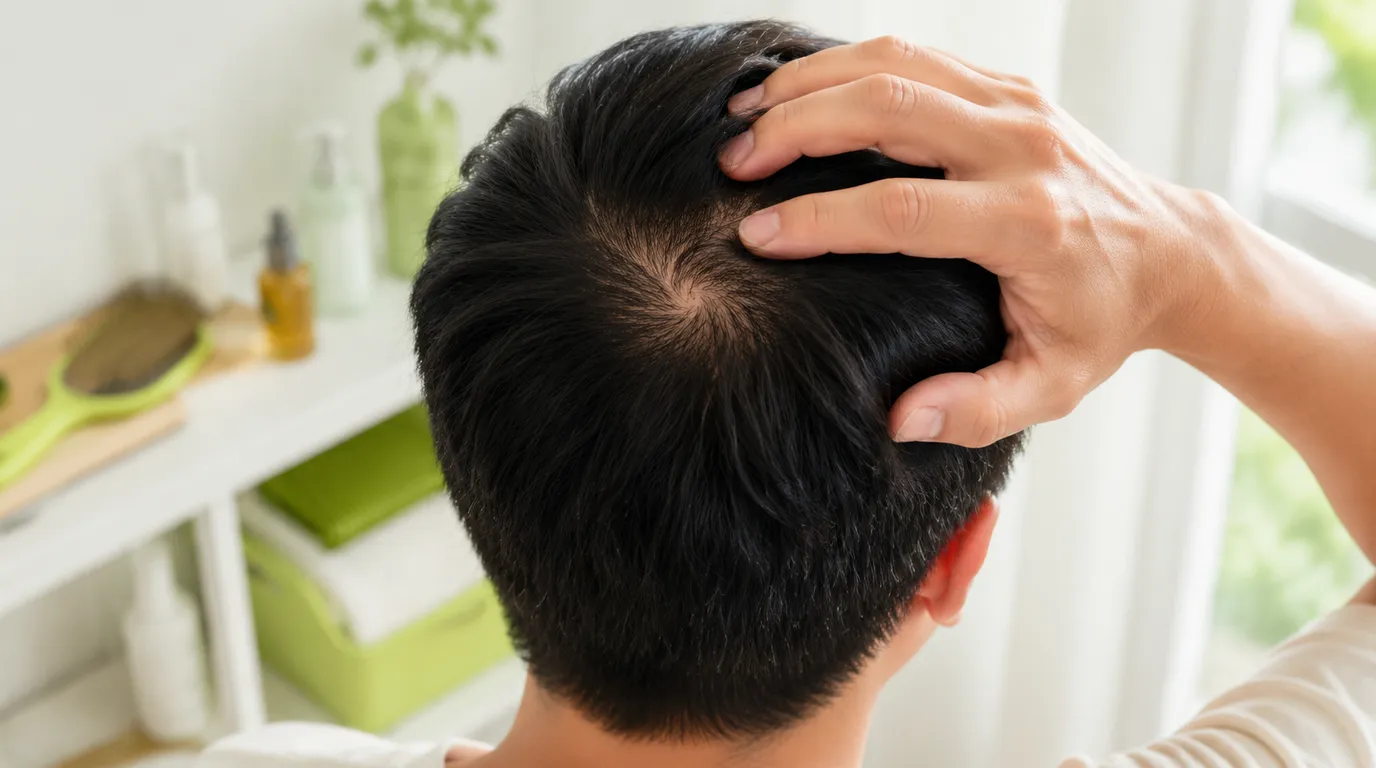
"Hair density" is one of those phrases that sounds precise until you try to pin it down. People use it to mean how full their hair looks, how thick each strand feels, how much scalp shows through under the bathroom light, and a specific number a clinic could write on a chart. Those are four different things, and conflating them is exactly how the hair-loss-panic industry sells you a number that doesn't mean what you think it means.
I built ScalpAnalysis AI partly because I got tired of tools and apps handing men a confident-sounding "density score" off a single selfie. A flat phone photo physically cannot do what those numbers imply. So this is the honest version: what density really is, what a normal range looks like in general terms, how it's actually measured by people who do it for a living, and why the responsible thing for an at-home tool to report is a coverage tier you track over time, not a fake count. We don't sell you thicker hair. We sell you an honest baseline.
What hair density actually means
In clinical terms, hair density is simple: the number of hairs growing in a fixed area of scalp, almost always expressed as hairs per square centimetre (hairs/cm²). That's it. It is a count, per unit of area, of a real physical thing.
What confuses people is that density is not the same as how full your hair looks. Perceived fullness is a combination of three separate variables, and density is only one of them:
- Density — how many hairs occupy each square centimetre of scalp.
- Caliber (thickness) — how wide each individual strand is. Fewer thick hairs can look fuller than more thin hairs.
- Contrast and coverage — how much the scalp shows through, which depends on hair color versus scalp color, how the hair lies, lighting, and whether it's wet or dry.
This matters because two men can have the same hairs/cm² and look completely different in the mirror. A man with fine, light hair over a pale scalp can look thinner than a man with coarse, dark hair over a darker scalp at the identical density. So when an app gives you a single "density number," ask which of these it's actually measuring. Usually it's measuring none of them precisely — it's measuring show-through and relabeling it.
What a normal range looks like
Here's where I'll be careful with numbers, because precision is exactly where most content lies to you. Across the literature, a commonly cited range for healthy adult scalp density sits roughly around 100 to 150 hairs per cm², with meaningful variation by person, scalp region, age, and ethnicity. The back of the head (occipital region) tends to run denser than the temples. Reported averages also differ across populations and across studies using different equipment, which is itself a clue: even trained researchers using magnified imaging get different baselines depending on method.
Treat any "normal range" as a loose general reference, not a pass/fail line. There is no single threshold where you cross from "fine" to "thinning." Density naturally varies, and what matters far more than where you fall in a population band is whether your own scalp is changing over time.
| Term | What it actually is | Can a phone photo measure it? |
|---|---|---|
| Density | Hairs per cm² (a count per area) | No — needs magnification to resolve and count strands |
| Caliber | Width of each individual hair shaft | No — needs magnified imaging to measure shaft diameter |
| Coverage / show-through | How much scalp is visible through the hair | Partly — visible at the surface, readable as a tier |
| Perceived fullness | Subjective look, driven by all three above plus lighting | No single number; appearance only |
How density is measured clinically
When density is measured properly, it is measured under magnification — not from a normal camera at arm's length. The standard tools share one feature: they zoom in close enough to resolve individual hair shafts so they can be counted and measured.
Dermoscopy / trichoscopy
A dermatoscope (when used on hair and scalp, called trichoscopy) magnifies a small patch of scalp. Method-standardization research notes that useful working magnifications run roughly 20-fold to 70-fold — and explicitly that a handheld 10x dermoscope gives a quick look but "does not precisely measure or document." In other words, even a 10x lens isn't enough for precise density and caliber; you need real magnification. A phone at selfie distance isn't remotely in this range.
Phototrichogram
A phototrichogram goes further. A small area (often 1 to 2 cm²) is clipped short, photographed under high-magnification digital imaging, then re-photographed after a couple of days. Software counts hairs, measures shaft thickness, and can even estimate the proportion of growing versus resting hairs. It's the kind of measurement that gives a real density number — and it requires clipping, controlled magnification, repeat visits, and software. That's the bar for an actual count.
Biopsy
In some cases a scalp biopsy is used, where follicles are counted under a microscope. This is the most definitive and the most invasive. The point of listing it is simple: every method that produces a trustworthy density number involves magnification or microscopy. None of them is a phone camera.
Why a phone photo can't count it
This is the honest core of the whole article, so I'll be blunt about the engineering. A phone photo of your scalp, taken from selfie or arm's-length distance, does not contain enough optical information to count hairs per square centimetre. Here's why, in plain terms:
- Resolution at distance: individual hairs near the scalp are far finer than what a phone sensor cleanly resolves once you back the camera off to frame your head. The strands blur into texture before they become countable dots.
- No fixed scale: counting per cm² requires knowing exactly how much real scalp area a region of pixels represents. A handheld photo has no fixed, known scale — distance and angle shift every shot.
- No caliber data: you cannot measure how wide a hair shaft is from a photo that can't even resolve the shaft. So the caliber half of "fullness" is simply unavailable.
- Lighting and wet/dry swing the look: the same head looks denser under flat soft light and thinner under harsh overhead light, and wet hair clumps to expose more scalp. None of that changes the actual count, but it changes any number you'd try to read off the surface.
So any tool that hands you "your density is 142 hairs/cm²" from a normal photo is, charitably, estimating from show-through and dressing it up as a count. I'd rather tell you what the photo can honestly support. When a view is genuinely unclear — bad light, motion blur, an angle that hides the area — the right answer is to say "unclear," not to guess a digit.
What we report instead: a coverage tier
What a phone photo can honestly read is coverage — how much scalp shows through the hair in a given region — at the surface, in qualitative bands. So that's what ScalpAnalysis AI reports: a coverage tier (think low / medium / high show-through) for the areas a photo can actually see, each with a confidence level. It's a description of what's visible, not a measurement of what isn't.
This is why our method is built around four guided angles rather than one selfie. Each angle only reports what it can truly see. The top-down view can read part-line and mid-scalp show-through. The side reads the temples and hairline. The back reads the lower occipital area. And the crown is a genuine blind spot — you physically can't aim a phone straight down at the top-back of your own head, so we're honest about that rather than fabricating a crown reading from a bad angle.
The number that actually means something isn't a population density figure — it's the comparison between today's tier and your own earlier baseline at the same angle and lighting. One photo is a snapshot. Two matched photos are a trend. And stable is also a good answer: "no visible change since your last baseline" is genuinely useful information, even though it doesn't sell anything.
How to read your own show-through at home
You can't count density at home, but you can read coverage honestly and track it. The trick is consistency — you're comparing you to you, so everything except your hair should stay the same between checks.
- Use the same light every time. Soft, even daylight is best; harsh overhead spotlights exaggerate show-through. Avoid changing rooms between checks.
- Use the same angle and distance. The part-line and the crown show scalp most readily, so they're good repeatable spots. Take it the same way each time.
- Compare dry to dry, or wet to wet — never mix. Wet hair clumps and exposes more scalp, so a wet photo will always look 'thinner' than a dry one. Pick one and stay consistent.
- Date it and wait. Skin and hair change slowly. Re-check on the same-angle, same-light basis after about 8 to 12 weeks. Day-to-day shedding is noise; a matched comparison over weeks is signal.
- Look at change, not at a single frame. The question is never 'is this a good number' — it's 'has the show-through in this region moved compared with my own earlier photo?'
If you want help keeping that consistency and reading the tiers, that's exactly what an at-home tool is for. Our hair density test landing page is the narrow, do-it-now version of this; this article is the why behind it.
Questions
Good to know.
What is hair density?
Hair density is the number of hairs growing in a fixed area of scalp, usually expressed as hairs per square centimetre (hairs/cm²). It is a count per unit area — distinct from how thick each strand is (caliber) and from how full your hair looks overall (perceived fullness).
What is a normal or good hair density?
A commonly cited general range for healthy adult scalp is roughly 100 to 150 hairs per cm², with real variation by person, scalp region, age, and ethnicity. There's no single pass/fail threshold. What matters more than your spot in a population band is whether your own scalp is changing over time.
How is hair density measured?
Clinically, density is measured under magnification: trichoscopy (a dermatoscope at roughly 20x to 70x), a phototrichogram (a clipped, high-magnification area photographed and re-photographed so software can count and measure hairs), or, rarely, a scalp biopsy under a microscope. Every reliable method requires magnification — not a normal photo.
Can you measure hair density at home with a phone?
No — not as a true count. A phone photo at normal distance can't resolve individual strands, has no fixed scale to convert pixels to cm², and can't measure shaft thickness. What you can read at home is coverage (how much scalp shows through), as a qualitative tier, and track that against your own earlier photo at the same angle and light.
Why does my hair look thinner some days?
Lighting and whether your hair is wet or dry can change how much scalp shows through without changing your actual hair count. Harsh overhead light and wet, clumped hair both expose more scalp. That's why consistent same-light, same-angle, dry-to-dry comparisons matter far more than any single photo.
Does a coverage tier replace a real density count?
No, and we don't claim it does. A coverage tier is an honest description of what's visible at the surface, with a confidence level — not a measurement of hairs per cm². For an actual count or any medical concern, a board-certified dermatologist using magnified imaging is the right path. Our value is a consistent, appearance-based baseline you can track yourself.
Here's the position I'll stand behind. Density is a real, countable thing — and counting it honestly takes magnification you don't have in your pocket. So a responsible at-home tool shouldn't hand you a number it can't earn. It should tell you what your photo can truly show, say so with a confidence level, admit the crown is a blind spot, and then help you compare today against your own earlier baseline. We don't sell you a bigger number. We sell you an honest one you can watch over time. If a view is unclear, we'll say so.