
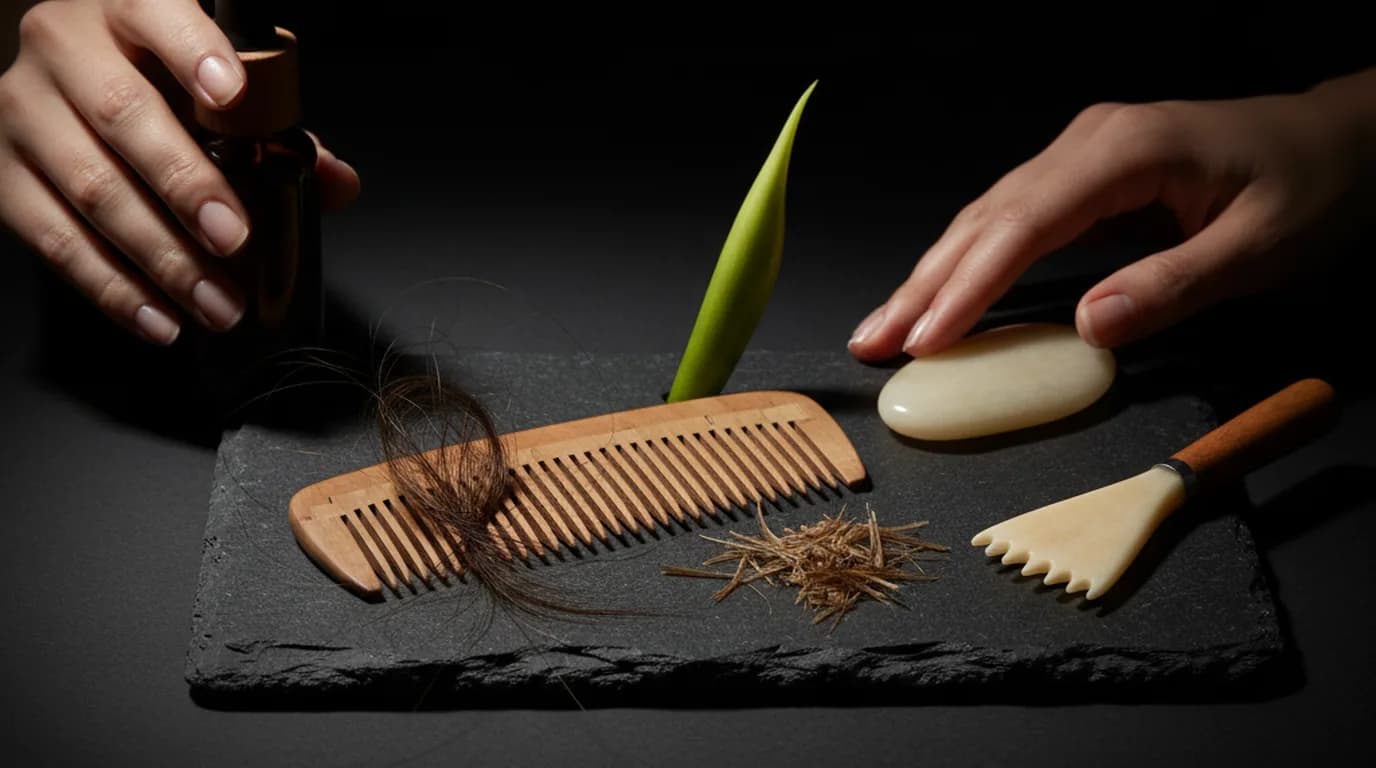
It usually starts the same way: hairs on the pillow, a clump in the shower drain, strands on your dark shirt that were not there before. The instinct is to assume the worst — that it is falling out and you are going bald. But there are two completely different things that leave hair everywhere, and they have opposite fixes. One is hair loss, where a whole strand leaves from the root. The other is breakage, where a strand snaps somewhere along its length while the root stays put. Telling them apart does not take a lab. It takes a good look at the hair itself.
This guide is an appearance-based way to tell the two apart and track which one you are seeing over time. It is not a diagnosis of the underlying cause. Once you know whether you are looking at shed hairs or snapped ones, you are pointed at the right question — and, if it matters to you, the right professional.
Is it hair loss or breakage? The one-look test
Pick up a few of the stray hairs and look closely at the ends under a good light. That single detail — what the ends look like — settles it faster than anything else.
So the one-look test is simply: does the hair have a little white or translucent knob at one end, or does it end in a rough, split, or blunt break? A bulb means the strand came out of the follicle — that is shedding or pattern loss. No bulb, plus a ragged end, means the strand broke partway along — that is breakage, and the follicle is still there.
What does a shed hair look like vs a broken hair?
The two ends tell two different stories, and once you have seen each a couple of times they are hard to confuse.
A shed hair (from the root)
A naturally shed hair has a small, smooth, pale swelling at one end — the bulb. It is usually white or translucent, sometimes slightly darker, and it is soft, not a hard root ball. The strand is roughly your full hair length, tapering to a fine natural tip at the other end. This is what a normally shed hair looks like, and losing plenty of them a day is expected — the widely cited rough range is around 50 to 100 hairs a day. Pattern loss also comes from the root, so those hairs carry a bulb too; the difference there is that they trend finer and shorter over months, not that they broke.
A broken hair (mid-shaft)
A broken hair has no bulb at either end. One end is a natural tip; the other is a break — frayed, split, feathered, or bluntly squared off, like the end of a snapped thread. Because it snapped partway along the shaft, it is usually shorter than your full length, and a scattering of broken hairs comes in a range of uneven lengths rather than all full-length. If you see lots of short, wispy hairs standing up along your part or around your hairline — too short to be new growth and too short to be shed full strands — that is a classic breakage signal.
Where you find the hairs tells you which problem it is
Location and length are the two clues that back up the end-of-the-hair test. Shed hairs and broken hairs tend to collect in different places for mechanical reasons.
- Full-length hairs with a bulb, spread across your pillow, drain, and clothes, point toward shedding or pattern loss — the whole strand left the scalp.
- Short, uneven hairs with ragged ends, concentrated where hair takes the most stress — the hairline, the part, the nape, or wherever a tie or brush pulls — point toward breakage.
- Broken hairs often show up on the sink, the shoulders, and in the brush more than on the pillow, because breakage happens during handling: brushing, towel-drying, tight styling, heat.
- A fringe of short, upright, broken hairs along the front hairline is common with breakage and is easy to mistake for regrowth — regrowth is soft and tapered at the tip, a broken hair is blunt or frayed.
None of these on their own is proof — a single clue can mislead. But when the end of the hair, its length, and where you find it all agree, you have a confident read on which of the two you are dealing with.
Hair loss vs breakage: side-by-side comparison
Here is the whole distinction in one place. Read down the column that matches what you are seeing on your own hairs.
| What you check | Hair loss (shedding / pattern) | Breakage |
|---|---|---|
| Where it comes from | The root — the strand leaves the follicle | The mid-shaft — the strand snaps, follicle stays |
| The end of the strand | A tiny pale, smooth bulb | A frayed, split, or blunt break; no bulb |
| Length of stray hairs | Roughly full-length and consistent | Shorter and uneven, a mix of lengths |
| Where you find them | Pillow, drain, clothes — everywhere | Sink, shoulders, brush; short bristly hairs along part and hairline |
| What it usually means | Normal shedding, a temporary shed, or pattern change | The follicle is fine; the hair is being damaged and weakening |
Worth knowing: the two can happen at once, and one issue that comes from the root — a temporary all-over shed after stress or illness — is a separate axis again. For the difference between a temporary shed and a longer-term pattern, both of which come from the root, our companion guide on shedding versus hair loss covers that side. This page is about the other split: root versus mid-shaft.
What causes mid-shaft breakage (and why it's different)
Breakage matters as its own category because the fix is usually about how you handle your hair, not what is happening in the follicle. The follicle is healthy; the strand is simply being weakened and snapped. Common contributors to that mechanical and chemical stress include:
- Heat — frequent high-heat styling or drying that dries out and embrittles the shaft.
- Tension — tight ponytails, buns, or man-buns that pull the same hairs repeatedly, along with aggressive brushing, especially on wet hair when strands are most fragile.
- Chemical stress — bleaching, harsh colouring, or over-processing that leaves the shaft porous and weak.
- Friction and dryness — rough towel-drying, coarse pillowcases, and very dry hair that has lost its flexibility.
This is why the distinction is practical, not academic. If your stray hairs are broken, gentler handling — less heat, looser styles, a wide-tooth comb, no brushing soaking-wet hair — targets the actual mechanism. If your stray hairs are shed with a bulb, that same routine change will not do much, because the strand is leaving from the root and the answer lies elsewhere. Naming the pattern keeps you from spending months on the wrong fix. It does not, on its own, tell you the cause of shedding — for that, a qualified professional is the right call.
How to photograph and track the difference over time
The end of a single hair is tiny, and “it seems worse lately” is a feeling, not evidence. Both problems get easier to read when you capture them the same way and compare over time instead of trusting memory.
- Photograph the hairs themselves: lay a few stray strands on a plain, contrasting background — a shed hair reads dark on white paper — and shoot close under soft, even light so the ends are in focus. Zoom in on your phone screen to check for a bulb versus a frayed break.
- Photograph the areas that show breakage: the front hairline and the part, where short upright broken hairs collect, from the same angle and distance each time.
- Keep the setup identical between sessions — same light, same distance, same dry hair — so any change you see later reflects your hair, not your camera. Every 8 to 12 weeks is a sensible rhythm; visible change is slow.
- Save the first set as a baseline and compare against it, not against your worst-fear version from memory. A stable, unchanged comparison is a genuinely good result to get.
If holding all those variables steady by hand sounds fiddly, that is exactly what a guided scan is for: fixed framing on four angles, an appearance-based read on visible signals, a confidence level on every reading, and your result saved as a baseline so the next scan compares fairly against your first. You can preview a full report free, without an account, and judge for yourself whether the read is honest.
When neither a photo nor a comparison is enough
The bulb-versus-break test is genuinely useful, but it has honest limits. It tells you where a strand came apart — root or shaft — and nothing about why. It cannot name a condition, measure your hair, or see anything beneath the skin. Plenty of people have some of both at once, and appearances can overlap.
Used within those limits, the distinction is one of the most useful things you can learn about your own hair. Look at the end of the strand, note its length, see where it collects — and you will know whether to change how you handle your hair or to ask a different question entirely.
Questions
Good to know.
Is my hair breaking or falling out?
Look at the end of a stray hair. If it has a tiny pale bulb at one end and is roughly full-length, it was shed from the root — that is falling out (normal shedding or pattern loss). If it has a frayed, split, or blunt end with no bulb and is shorter than your full length, it snapped mid-shaft — that is breakage, and the follicle is still fine.
What does the bulb on a shed hair mean?
The small pale swelling is the base of the strand that sat in the follicle. Its presence just means the whole hair left from the root — which is what naturally shed hairs do. It is not a sign of damage by itself, and a soft pale bulb is normal; losing roughly 50 to 100 hairs a day like this is expected.
Why do I have lots of short hairs along my hairline?
Short hairs at the front can be either new regrowth or broken hairs, and they are easy to confuse. Regrowth is soft and tapers to a fine point; a broken hair ends in a blunt or frayed break. If those short hairs feel wiry and end abruptly, they point to breakage from styling stress rather than new growth.
Can I have both hair loss and breakage at the same time?
Yes. They are separate problems and can happen together, which is part of why they get confused. Checking the ends and lengths of several stray hairs — rather than judging from one — gives a clearer read on whether one, the other, or both are in play.
Is telling loss from breakage a diagnosis?
No. It is an appearance-based way to tell two patterns apart and track change over time. It does not identify the cause of either and does not diagnose, treat, or cure anything. For sudden shedding, patchy loss, or a sore or scaling scalp, see a qualified professional.